

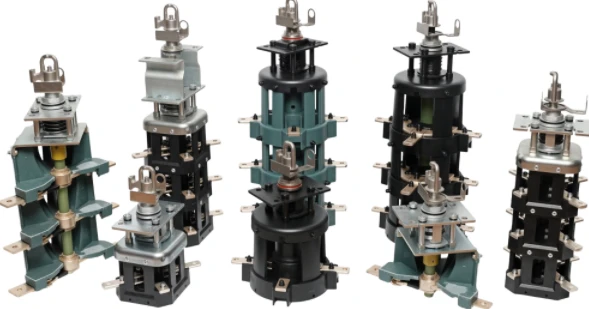
The Core of Pad-Mounted Transformers: An Analysis of the Four-Position Loadbreak Switch
In the compact design of pad-mounted transformers, the four-position loadbreak switch (LBS) is the core component that determines power supply reliability and operational safety. It is not merely a simple on-off device but the "command center" for achieving loop-feed distribution, dual-source transfer, and fault isolation. This article provides an in-depth analysis of the technical logic, selection criteria, and strategic value of this critical component in distribution systems.
1. What Does "Four-Position" Mean? – More than On/Off, It's About Logic
This switch is typically configured on the high-voltage side of pad mounted transformers. Its core value lies in achieving four distinct circuit states through a single rotary handle. These four states are not random arrangements but are designed based on specific grid topology requirements:
Terminal Position (Line A ON, Line B OFF): The transformer is supplied by the primary source A, with B as backup or disconnected.
Terminal Position (Line A OFF, Line B ON): The transformer is transferred to the backup source B.
Loop Position (A ON, B ON): Both sources are connected, enabling loop-feed operation-ensuring continuous supply even during maintenance on one line.
Open Position (A OFF, B OFF): The transformer is fully isolated from the grid, ensuring safe maintenance.
This configuration meets the flexible demands of pad mounted transformers in loop-feed, dual-source, or terminal supply systems. Unlike circuit breakers, the loadbreak switch is specifically designed to interrupt normal load currents and overload currents (typically rated up to 630A) but is not intended to interrupt short-circuit fault currents-a task delegated to the series-connected backup fuse.
2. Blade Selection Logic: Physical Structure Defines Safety Boundaries
Depending on the application scenario, manufacturers offer various blade configurations. Incorrect selection can not only compromise functionality but also trigger dangerous loop-closing incidents. Below is a comparison of two mainstream types:
A. Selector Blade (Codes D/R/L)
Typical Application: Dual-source manual transfer (requiring absolute physical isolation)
This design employs a single-pole, single-throw logic. Any transition from one source to the other must pass through a definitive "Open" position (hardwired "Break Before Make").
This physical mechanism structurally eliminates the possibility of unintended source paralleling. It is especially suitable for data centers or scenarios with strict phase synchronization requirements, preventing massive circulating currents caused by asynchronous source paralleling.
B. V-Blade (Code V)
Typical Application: Urban loop distribution networks (requiring uninterrupted supply)
The V-Blade design allows for a brief overlap of the two sources ("Make Before Break"), achieving load transfer without interruption during source switching.
Risk Note: This functionality depends on the two sources being fully synchronized in phase, frequency, and voltage. Otherwise, the brief parallel connection will effectively be a short-circuit event.
3. Engineering Advantages of Oil-Immersed Design
Why is the loadbreak switch in pad mounted transformers predominantly oil-immersed? This design places the switch directly inside the transformer tank, utilizing the transformer oil as both insulation and arc-quenching medium. This integrated approach offers significant advantages:
Compact Footprint: Eliminates the need for separate gas-insulated cabinets, significantly reducing the transformer's physical size.
Anti-Resonance Capability: Installation close to the transformer core minimizes internal connection cable capacitance, significantly reducing the risk of ferroresonance.
Operating Mechanism: Utilizes manually charged over-toggle stored spring assembly. The closing and opening speeds are independent of manual operating speed, ensuring reliable arc extinction.
4. Selection Recommendations for Your Station
If you are specifying or procuring for your project, it is advisable to define requirements based on the following logic:
Strict Safety Requirements (e.g., Data Centers, Hospitals): Must select Selector Blade (Type D/R), enforcing "Break Before Make" to eliminate any risk of unintended paralleling.
Operational Continuity Requirements (e.g., Commercial Districts, Industrial Parks): May select V-Blade to achieve seamless source transfer, but ensure the upstream sources are capable of synchronization.
Parameter Verification:
Rated Voltage: Common ratings 15kV / 25kV / 35kV .
Rated Current: Industry standard is typically 630A .
Mechanical Life: 3000 operations min.